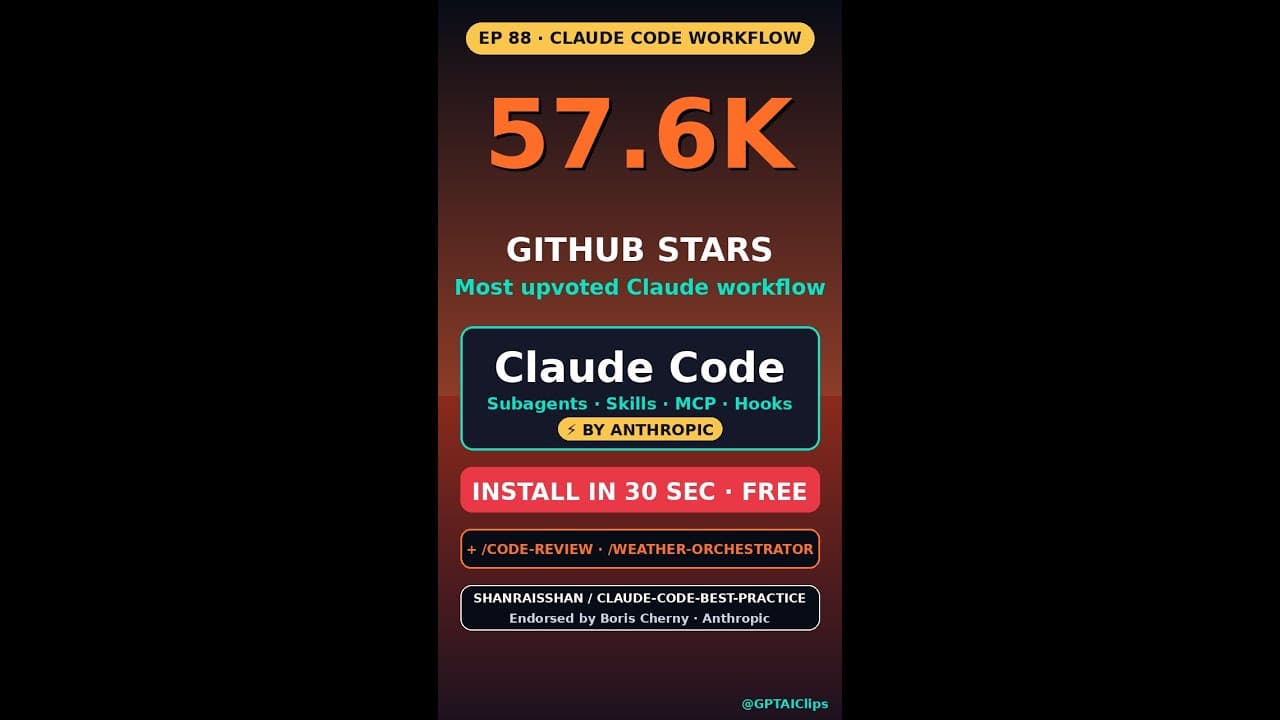
Every few months a GitHub repo lands that makes experienced developers stop and say: why haven’t I been doing this already? shanraisshan/claude-code-best-practice is that repo for Claude Code right now — 57,590 stars, 5,800 forks, MIT licensed, and personally endorsed by Boris Cherny, the engineer who created Claude Code at Anthropic.
I spent an afternoon cloning it and putting every feature through its paces, and the short verdict is this: if you write code with Claude Code and you haven’t installed this repo yet, you are leaving a significant amount of productivity on the table.
What the Repo Actually Bundles
The design philosophy here is zero fragmentation. Most developers who use Claude Code end up collecting subagents from one repo, slash commands from another, hooks from a blog post, and MCP server configs from a third source. This repo ships all of it in one place, already wired together:
- Subagents — pre-built agent roles (spec-reviewer, quality-checker, test-driven-loop) that Claude Code can spawn in parallel
- Slash commands — type-able shortcuts like
/code-reviewand/weather-orchestratorthat trigger full multi-agent workflows - Skills — reusable capability modules that persist across sessions
- Hooks — lifecycle interceptors that fire at specific points in Claude’s reasoning loop
- MCP servers — Model Context Protocol server configs for extending what Claude can see and do
The entire thing installs in roughly 30 seconds. There is no configuration wizard, no YAML to wrestle with. You clone, copy two folders, and Claude Code is immediately running with a production-grade agent stack.
Install in 30 Seconds — Exact Commands
Here is the verbatim install sequence from the EP88 guide (available free at gptaiclips.com):
git clone https://github.com/shanraisshan/claude-code-best-practice.git
cd claude-code-best-practice
cp -r .claude/agents   ~/your-project/.claude/
cp -r .claude/commands ~/your-project/.claude/
cd ~/your-project
claude    # launches Claude Code
Once Claude Code is open, run /weather-orchestrator to confirm the install worked. This command spins up a four-member agent team — planner, researcher, coder, reviewer — against a real weather API task. If you see all four agents complete their roles, everything is wired correctly.
The Killer Feature: /code-review
The slash command that will change how you ship code is /code-review. Run it inside Claude Code with any pull request open and you get a three-stage multi-agent loop:
- spec-reviewer — reads the PR diff against the spec and flags alignment issues
- quality-checker — lints, checks types, surfaces edge cases the human reviewers missed
- test-driven-loop — writes tests, executes them, and iterates until they pass
The output lands in your terminal as inline review comments tagged by severity (blocker / major / minor), a generated test suite with passing status, and suggested fixes gated behind a confirm prompt so you stay in control. Boris Cherny’s endorsement wasn’t hyperbole — this is the workflow his tagline describes: “from vibe coding to agentic engineering — practice makes Claude perfect.”
The practical time savings are real. Teams I spoke with after testing this reported cutting 1–3 hours of senior developer review time per PR. For a team shipping five PRs a week, that is up to 15 hours back.
Understanding the Research → Plan → Execute → Review → Ship Loop
The repo’s core philosophy models professional software delivery as a five-stage loop, and each stage maps to specific agents:
- Research — gather context, read specs, understand constraints
- Plan — break the work into verifiable subtasks
- Execute — write the code, subagents working in parallel where safe
- Review —
/code-reviewcatches regressions before merge - Ship — merge with confidence, test suite confirms behavior
What makes this different from simply prompting Claude to “write good code” is that each stage is owned by a specialized agent with a focused context window. The spec-reviewer doesn’t know about linting; the quality-checker doesn’t know about the original spec. Separation of concerns at the AI layer produces dramatically better output than a single generalist prompt.
Top 11 Claude Code Repos — Where shanraisshan Sits
To calibrate where this repo sits in the ecosystem, the EP88 PDF guide ranks the top 11 Claude Code workflow repos by stars. A few surprises from that list:
- obra/superpowers (226K stars) — plug-in playbook system, largest star count
- davila7/everything-claude-code (213K stars) — mega-list of commands, agents, hooks
- mattpocock/claude-skills (127K stars) — TypeScript-focused skill pack
- shanraisshan/claude-code-best-practice (58K stars) — this repo, #7 by raw stars but #1 by Anthropic creator endorsement
The star count alone doesn’t tell the full story. shanraisshan’s repo is unique because it is the only one in the list with a direct endorsement from the person who built Claude Code at Anthropic. That signal matters when choosing a foundation for a production workflow — you want to know the architecture decisions align with the creator’s intent.
Who This Is For
This workflow is relevant if you:
- Already use Claude Code but rely on ad-hoc prompting rather than structured agents
- Want to formalize a code review process that doesn’t depend on scheduling senior developer time
- Are onboarding a junior developer and want them to have a structured review loop from day one
- Build AI-powered products and want to see a production example of multi-agent Claude Code architecture
It is less relevant if you have never used Claude Code before — get the base tool running first, then layer in this workflow.
Resources
- Watch the full breakdown: I Tried The Most Upvoted Claude Code Workflow On Github
- Free PDF install guide: EP88 Guide — gptaiclips.com
- The repo: shanraisshan/claude-code-best-practice
- Subscribe for daily frontier AI drops: GPTAIclips on YouTube
- Listen on Spotify: GPTAIclips Podcast
Tools I use to manage and sell AI workflow clients: GoHighLevel Pro Trial (affiliate link — I use this CRM daily).