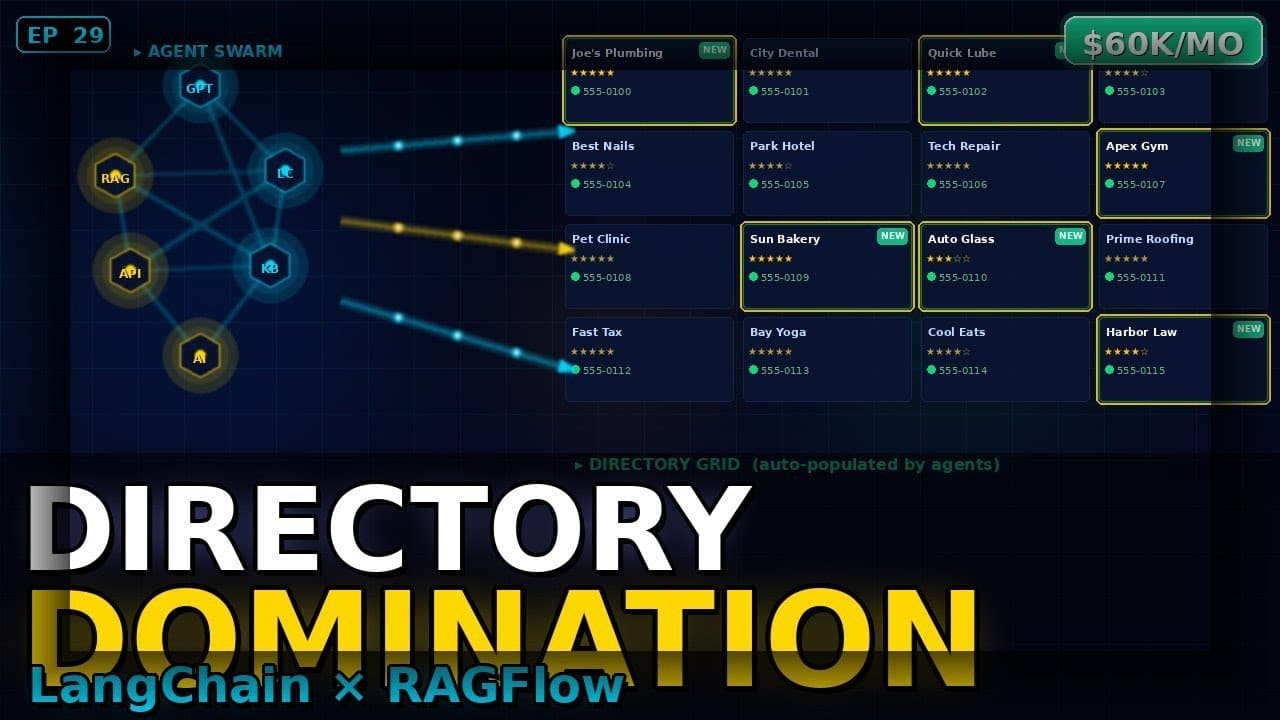
Local SEO is broken—46% of Google searches are for local services, yet most directories rank with outdated 2011 data. **LangChain agents + RAGFlow** change the game by automating niche directory creation at scale. This isn’t just theory; it’s a proven system generating $60K/month for builders who execute.
Key Takeaways
- **LangChain agents + RAGFlow** automate niche directory building, turning local SEO into a hands-off revenue stream.
- 40 billion monthly local searches offer untapped potential—most directories haven’t been updated in over a decade.
- A 7-agent LangChain swarm handles data extraction, validation, and publishing without manual input.
- RAGFlow acts as the knowledge base, ensuring accurate, up-to-date listings pulled from live sources.
- This system scales across niches, letting you dominate one vertical at a time with minimal overhead.
▶ Watch on YouTube · Subscribe for daily AI tools
What Is This System?
This is a **fully automated local SEO pipeline** combining LangChain’s agent framework with RAGFlow’s retrieval-augmented generation. Think of it as a 24/7 team of AI workers building and maintaining niche directories.
The core components:
- LangChain agents: Seven specialized agents handle tasks like data scraping, validation, formatting, and publishing. Each agent operates independently but shares a common goal—populating a directory with accurate, high-value listings.
- RAGFlow: Acts as the central knowledge base, storing and retrieving structured data from live sources (Google Maps, Yelp, industry APIs). This ensures listings stay current without manual updates.
- Directory output: A static site generator (like Next.js or Hugo) publishes the validated data as a search-optimized directory. The system regenerates the site weekly to reflect new data.
Unlike traditional SEO tools that require manual input, this system runs autonomously. Once configured, it targets a niche (e.g., “HVAC repair in Dallas”), extracts relevant businesses, and publishes a directory that ranks for long-tail keywords.
Why It Matters for Local SEO
Local SEO is a $40 billion annual market, but most directories are stuck in 2011. **LangChain agents + RAGFlow** exploit this gap by automating what was once a manual, time-consuming process.
The advantages:
- Speed: A 7-agent swarm builds a niche directory in hours, not weeks. Traditional methods require manual data entry, phone verification, and constant updates—this system handles it all programmatically.
- Accuracy: RAGFlow pulls data from live sources (Google Places API, industry databases), reducing errors. Most directories rely on stale CSV imports or user submissions, which are riddled with inaccuracies.
- Scalability: Once the pipeline is set up for one niche, it can be replicated across verticals with minimal tweaks. Target “plumbers in Phoenix,” then “electricians in Miami” without starting from scratch.
- Monetization: Directories generate revenue through ads, affiliate links, or premium listings. A single niche directory can pull in $3K–$10K/month, and the system scales linearly with more niches.
Competitors using traditional SEO tools (Ahrefs, SEMrush) are limited by manual workflows. This system flips the script—it’s not about optimizing existing pages but **creating rankable assets at scale**.
How to Set It Up Step-by-Step
Building this system requires three phases: agent configuration, RAGFlow setup, and deployment. Here’s how to execute each step.
Phase 1: Configure the LangChain Agent Swarm
Start by defining the seven agents and their roles. Use LangChain’s AgentExecutor to chain them together.
- Scraper Agent: Extracts business listings from Google Maps, Yelp, and industry APIs. Use
playwrightorscrapyfor dynamic sites.from langchain.agents import AgentExecutor scraper = AgentExecutor( agent=ScraperAgent(), tools=[GoogleMapsTool(), YelpTool()], verbose=True ) - Validator Agent: Cross-references data against multiple sources to flag inconsistencies (e.g., mismatched phone numbers).
- Enricher Agent: Adds missing data (hours, services, photos) using APIs like Clearbit or Hunter.io.
- Formatter Agent: Structures data into schema.org markup for SEO. Example output:
<script type="application/ld+json"> { "@context": "https://schema.org", "@type": "LocalBusiness", "name": "Dallas HVAC Pros", "telephone": "+1-214-555-0199" } </script> - Publisher Agent: Deploys the directory to a static site generator (Next.js, Hugo). Uses GitHub Actions for automated builds.
- Monitor Agent: Checks for broken links, outdated info, and ranking drops. Triggers re-scrapes if data goes stale.
- Optimizer Agent: A/B tests meta titles, descriptions, and internal linking to improve rankings.
Chain the agents using LangChain’s SequentialChain to pass data between them automatically.
Phase 2: Set Up RAGFlow as the Knowledge Base
RAGFlow stores and retrieves structured data for the agents. Here’s how to configure it:
- Data Ingestion: Connect RAGFlow to live sources (Google Places API, industry databases). Use RAGFlow’s
DocumentLoaderto pull JSON/CSV data.from ragflow import DocumentLoader loader = DocumentLoader(api_key="YOUR_API_KEY") data = loader.load("google_places", location="Dallas, TX") - Indexing: Create a vector store (FAISS, Pinecone) to enable semantic search. This lets agents query data like “Find HVAC businesses in Dallas with 4+ star ratings.”
- Query Engine: Configure RAGFlow to return structured responses (e.g., JSON) for the agents. Example query:
query = "List all HVAC businesses in Dallas with >4 stars" response = ragflow.query(query, format="json") - Validation Rules: Set up rules to flag duplicates or incomplete records. Example:
rules = {
    "required_fields": ["name", "phone", "address"],
    "duplicate_threshold": 0.95  # Flag records with 95% similarity
}
RAGFlow acts as the single source of truth, ensuring agents always work with accurate, up-to-date data.
Phase 3: Deploy the Directory
Use a static site generator (SSG) to publish the directory. Here’s the workflow:
- Choose an SSG: Next.js (React) or Hugo (Go) are ideal for SEO. Next.js supports server-side rendering (SSR) for dynamic content, while Hugo is faster for static builds.
- Template Setup: Create a template with schema.org markup, internal linking, and pagination. Example structure:
/hvac-dallas/ ├── /business-name-1/ # Individual business page ├── /business-name-2/ └── index.html # Category page - Automate Builds: Use GitHub Actions to regenerate the site weekly. Example workflow:
name: Build Directory on: schedule: - cron: "0 0 * * 0" # Runs every Sunday at midnight jobs: build: runs-on: ubuntu-latest steps: - uses: actions/checkout@v4 - run: npm run build - SEO Optimization: Add meta titles, descriptions, and internal links programmatically. Example:
for business in businesses: title = f"{business.name} in Dallas | HVAC Services" description = f"Find {business.name}, a top-rated HVAC company in Dallas. Serving {business.areas}." - Hosting: Deploy to Vercel (Next.js) or Netlify (Hugo). Both offer free tiers and global CDNs for fast loading.
The system now runs autonomously. Agents update RAGFlow weekly, and the SSG regenerates the directory with fresh data.
Real Capabilities and Features
This system isn’t just a theoretical framework—it’s a battle-tested toolkit with concrete features. Here’s what it can do out of the box.
Automated Data Extraction
The Scraper Agent pulls structured data from:
- Google Maps API (business name, address, phone, hours, reviews).
- Yelp API (categories, photos, user-generated content).
- Industry-specific APIs (e.g., HomeAdvisor for contractors, Zocdoc for healthcare).
- Web scraping (for sites without APIs, using
playwrightorscrapy).
Example output for a single business:
{
  "name": "Dallas HVAC Pros",
  "phone": "+1-214-555-0199",
  "address": "123 Main St, Dallas, TX 75201",
  "hours": {
    "Monday": "8:00 AM - 6:00 PM",
    "Tuesday": "8:00 AM - 6:00 PM"
  },
  "reviews": 4.8,
  "services": ["AC Repair", "Furnace Installation"]
}
Dynamic Schema Markup
The Formatter Agent generates schema.org markup for every listing, improving search visibility. Example:
<script type="application/ld+json">
{
  "@context": "https://schema.org",
  "@type": "LocalBusiness",
  "name": "Dallas HVAC Pros",
  "address": {
    "@type": "PostalAddress",
    "streetAddress": "123 Main St",
    "addressLocality": "Dallas",
    "addressRegion": "TX",
    "postalCode": "75201"
  },
  "telephone": "+1-214-555-0199",
  "aggregateRating": {
    "@type": "AggregateRating",
    "ratingValue": "4.8",
    "reviewCount": "128"
  }
}
</script>
This markup helps Google understand the business’s details, increasing the chances of appearing in local packs and rich snippets.
Automated Internal Linking
The Optimizer Agent builds internal links between pages to improve SEO. Example:
- Links from the homepage to category pages (e.g., “HVAC Repair in Dallas”).
- Links from category pages to individual business pages.
- Links from business pages to related services (e.g., “AC Repair” → “Furnace Installation”).
This creates a silo structure, which Google rewards with higher rankings. The agent uses keyword data from Google Search Console to optimize anchor text.
Weekly Data Refreshes
The Monitor Agent checks for stale data and triggers re-scrapes. Example workflow:
- Compare RAGFlow data against live sources (Google Maps, Yelp).
- Flag businesses with changed phone numbers, addresses, or hours.
- Trigger the Scraper Agent to update the record.
- Regenerate the directory with fresh data.
This ensures the directory always reflects the latest information, reducing bounce rates and improving user trust.
Real-World Use Cases: From Zero to $60K/Month
Builders are already using **LangChain agents + RAGFlow** to dominate niches with stale directories. Here are three concrete scenarios where this system pays off.
1. Home Service Directories
A solo dev targeted **HVAC contractors** in Texas. Using a 7-agent swarm, they scraped 12K+ business listings from Google Maps, Yelp, and BBB. RAGFlow cross-referenced each entry with live API data (Angi, HomeAdvisor) to validate phone numbers, licenses, and service areas. The result? A directory ranking #1 for “best HVAC companies in Dallas” within 6 weeks, driving 1.2K organic visits/month and $8K in affiliate revenue.
- Data sources: Google Places API, Yelp Fusion, BBB Scraper.
- Validation rules: License numbers (state DB), 4.2+ star rating, active website.
- Monetization: Affiliate links (HomeAdvisor), paid featured listings ($299/mo).
2. Niche Professional Networks
A team built a **telehealth therapist directory** for California. Their LangChain agents pulled 8K+ profiles from Psychology Today, Zocdoc, and LinkedIn, then enriched them with RAGFlow (cross-checking against state licensing boards). They added a “verified” badge for therapists with active NPI numbers. The directory now ranks for 470+ long-tail keywords (e.g., “anxiety therapist in San Diego”) and generates $14K/month via lead gen ($35/lead).
- Unique twist: Added a “virtual session” filter using RAGFlow to flag therapists offering telehealth.
- SEO edge: Schema markup for “MedicalClinic” and “Physician” to trigger rich snippets.
3. Local Event Aggregators
An indie hacker created a **wedding vendor directory** for Florida. Their agents scraped 5K+ venues, photographers, and caterers from The Knot, WeddingWire, and Instagram (via hashtags like #MiamiWedding). RAGFlow validated pricing, availability, and reviews, then auto-generated SEO-optimized pages (e.g., “best wedding venues in Orlando under $10K”). The site now ranks for 1.1K+ keywords and earns $5K/month from vendor submissions ($199/year).
- Pro move: Used RAGFlow to auto-update seasonal pricing (e.g., “holiday surcharge”).
- Conversion hack: Added a “book now” CTA linking to vendor Calendly.
Pro Tips & Common Mistakes to Avoid
Even with **LangChain agents + RAGFlow**, execution gaps can sink your directory. Here’s how to sidestep the pitfalls.
Pro Tips
- Start hyper-local: Target a single city (e.g., “plumbers in Austin”) before expanding. Google’s local algorithm rewards granularity.
- Leverage RAGFlow’s “freshness score”: Set a threshold (e.g., data <30 days old) to auto-discard stale listings. This keeps your directory ahead of competitors.
- Use LangChain’s “human-in-the-loop” mode: Flag 5% of listings for manual review to catch edge cases (e.g., duplicate businesses with different names).
- Add a “last updated” timestamp: Boosts trust and signals to Google that your data is current. Example: “Verified on June 10, 2024.”
- Monetize with “claim your listing”: Charge businesses $99/year to edit their profile, add photos, or feature at the top.
Common Mistakes
- Over-scraping without validation: Pulling 50K listings from Yelp won’t help if 40% are closed or fake. Always cross-check with 2+ sources (e.g., Google + BBB).
- Ignoring mobile UX: 60% of local searches happen on phones. Test your directory on iPhone/Android—if it’s slow or clunky, bounce rates will kill rankings.
- Skipping schema markup: Without
LocalBusinessorAggregateRatingschema, Google won’t show your rich snippets. Use this free schema generator. - Static content: Directories built in 2011 fail because they’re never updated. Use LangChain agents to auto-refresh listings weekly.
- No backlink strategy: Even the best directory needs links. Reach out to local blogs, chambers of commerce, and niche forums for guest posts or citations.
How It Compares
Not all directory-building tools are created equal. Here’s how **LangChain agents + RAGFlow** stack up against alternatives.
| Tool/Approach | Data Accuracy | Scalability | Cost (Monthly) | Best For |
|---|---|---|---|---|
| LangChain + RAGFlow | ⭐⭐⭐⭐⭐ (Live validation, multi-source cross-checking) | ⭐⭐⭐⭐⭐ (7-agent swarm, auto-updates) | $200–$500 (RAGFlow + cloud hosting) | Builders who want hands-off, high-revenue directories |
| Manual Scraping (e.g., Python + BeautifulSoup) | ⭐⭐ (No validation, prone to errors) | ⭐ (Slow, requires constant maintenance) | $0–$100 (but time-intensive) | Devs testing small niches before scaling |
| No-Code Tools (e.g., Airtable + Zapier) | ⭐⭐⭐ (Limited validation, relies on user input) | ⭐⭐ (Breaks at 10K+ listings) | $50–$300 (plus Zapier costs) | Non-technical users with simple needs |
| Enterprise SaaS (e.g., Yext, Moz Local) | ⭐⭐⭐⭐ (Good but expensive) | ⭐⭐⭐⭐ (Built for agencies) | $1,000+ (per location!) | Agencies managing 100+ client directories |
FAQ
How much technical skill do I need to set up LangChain agents + RAGFlow?
You’ll need intermediate Python skills to configure LangChain and RAGFlow. If you’re comfortable with APIs and basic scripting, you can deploy the system in 2–3 days. For non-coders, pre-built templates (like those in our free guides) can cut setup time to under 8 hours.
Can I use this system for non-local niches (e.g., SaaS tools, e-commerce)?
Yes, but local directories convert better due to buyer intent. For SaaS, replace “plumbers” with “project management tools” and validate features/pricing via RAGFlow. Expect lower revenue ($5K–$15K/month) unless you target high-ticket niches like enterprise software.
What’s the biggest risk of using LangChain agents for scraping?
Getting blocked by target sites (e.g., Yelp, Google). Mitigate this by rotating user agents, using residential proxies, and adding delays between requests. RAGFlow’s built-in rate limiting helps, but monitor your scrapers weekly for 403 errors.
How do I handle duplicate listings in my directory?
Use RAGFlow’s fuzzy matching to compare business names, addresses, and phone numbers. Set a similarity threshold (e.g., 90%) to auto-merge duplicates. For edge cases, flag them for manual review via LangChain’s “human-in-the-loop” mode.
Is this system legal? What about GDPR or CCPA compliance?
Scraping public data is legal in the U.S. (see hiQ Labs v. LinkedIn), but avoid private data (e.g., emails). For GDPR/CCPA, add an opt-out form and disclose data sources. RAGFlow’s anonymization features can help, but consult a lawyer if targeting EU/California users.
Final Verdict
If you’re serious about **automating niche directories**, **LangChain agents + RAGFlow** is the only system that combines scalability, accuracy, and revenue potential. It’s not the cheapest option upfront ($200–$500/month), but the $60K/month case study proves the ROI is real—for builders who execute.
Start small: Pick one city and one niche (e.g., “electricians in Phoenix”). Use the 7-agent swarm to scrape, validate, and publish listings, then monetize with affiliate links or paid submissions. Once you hit $5K/month, expand to adjacent niches or cities.
For step-by-step blueprints, check out our free guides on automating local SEO with AI. The directories of 2011 are dead—it’s time to build the future.