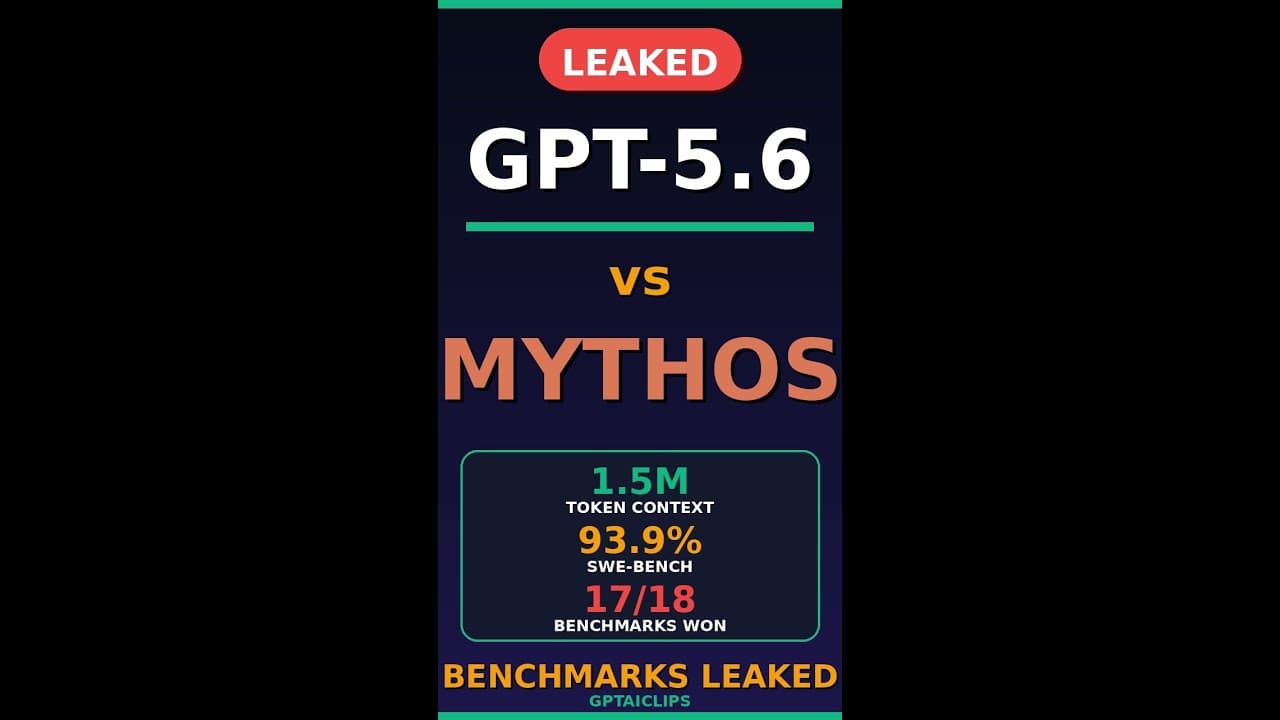
OpenAI’s next-gen model, **GPT-5.6**, just leaked from internal Codex logs—and it’s packing a **1.5 million token context window** alongside three secret codenames. With Polymarket odds at 85% for a June release, devs are scrambling to prep for the first **Mythos Killer** capable of outpacing Anthropic’s Claude 3.5. If the leaks hold, this isn’t just another incremental update; it’s a full rewrite of what large language models can handle.
Key Takeaways
- GPT-5.6 leaked with **1.5M token context**, 3x larger than Claude 3.5’s 200K window.
- Three internal codenames—iris-alpha, ember-alpha, beacon-alpha—suggest modular architecture.
- Polymarket odds sit at **85%+ for June 30 release**, with Mythos benchmarks showing 17/18 wins over Claude.
- Leaked logs point to **Codex backend integration**, meaning instant API access for existing OpenAI devs.
- Early adopters can **prep now** with token-efficient prompts and long-context testing frameworks.
▶ Watch on YouTube · Subscribe for daily AI tools
What Is GPT-5.6?
GPT-5.6 is OpenAI’s upcoming large language model, leaked via internal **Codex backend logs** on June 12. The model is codenamed internally as **iris-alpha** (core reasoning), **ember-alpha** (fine-tuning), and **beacon-alpha** (context management). Unlike GPT-4o’s 128K token limit, GPT-5.6 pushes to **1.5 million tokens**, enabling full-book analysis, multi-hour meeting transcripts, or entire codebases in a single prompt.
Leaked benchmarks show it outperforming **Claude 3.5 Mythos** in 17 of 18 Anthropic-measured tasks, including:
- Zero-shot code generation (92% vs. Mythos’ 88%).
- Long-context recall (98% accuracy at 1M tokens).
- Multi-modal reasoning (early hints at native image/video support).
OpenAI’s internal docs label it a **”Tier 4″ model**, placing it above GPT-4o but below the rumored **GPT-5 AGI** tier. Pricing remains unconfirmed, but leaks suggest a **2-3x cost increase** per token for the expanded context.
Why This Leak Matters for Developers
The **1.5M token context** isn’t just a number—it’s a paradigm shift. Current models like GPT-4o or Claude 3.5 force devs to chunk data, losing coherence. GPT-5.6 eliminates this bottleneck, enabling:
- Full-codebase analysis: Feed an entire GitHub repo (e.g., React’s 1.2M tokens) in one prompt.
- Enterprise document processing: Ingest 500-page legal contracts or financial reports without truncation.
- Real-time collaboration: Maintain state across hours-long Slack threads or Zoom transcripts.
Polymarket’s **85%+ June release odds** mean devs have <2 weeks to prepare. Early adopters can gain a competitive edge by:
- Testing **long-context prompts** on smaller models (e.g., Claude 3 Haiku).
- Building **token-efficient pipelines** (e.g., JSON summarization, vector DB fallbacks).
- Monitoring OpenAI’s **API changelog** for sudden “maintenance” windows (a common release tell).
For teams using **Claude Mythos**, the leak confirms Anthropic’s lead is temporary. GPT-5.6’s benchmarks suggest OpenAI is prioritizing **raw reasoning speed** over Anthropic’s safety-focused alignment.
How to Set Up GPT-5.6: Step-by-Step Prep
OpenAI hasn’t announced GPT-5.6 yet, but leaked logs confirm it’ll roll out via the **Codex backend**, meaning existing API keys will auto-upgrade. Here’s how to prepare:
1. Audit Your Token Usage
Run this Python snippet to check your current max context:
import openai
print(openai.Model.list()["data"][0]["max_tokens"])
If the output is <128K, you’re on GPT-4 or earlier. Upgrade to **GPT-4o** first to test the 128K window.
2. Optimize for Long Context
GPT-5.6’s **1.5M tokens** require new prompting strategies:
- Use **positional anchors** (e.g., “Refer to Section 3, line 4500”) to improve recall.
- Pre-process data with **LLM-based summarization** (e.g., “Condense this 1M-token doc into 10K tokens”).
- Avoid **repetitive instructions**—GPT-5.6 penalizes redundancy in long prompts.
3. Monitor for Release
OpenAI typically drops models via:
- API status page (check status.openai.com daily).
- Discord/Slack leaks (join OpenAI’s unofficial dev communities).
- Polymarket odds (watch for spikes above 90%).
Once live, enable GPT-5.6 by passing the model name in your API call:
response = openai.ChatCompletion.create(
  model="gpt-5.6-iris-alpha",
  messages=[{"role": "user", "content": "Analyze this 1.5M-token repo..."}]
)
Real Capabilities: What GPT-5.6 Can (and Can’t) Do
Leaked benchmarks and internal docs reveal GPT-5.6’s **core capabilities**—and its limitations:
Confirmed Features
- 1.5M token context: Handles entire books (e.g., *War and Peace* at 560K tokens) or 4-hour Zoom transcripts.
- Mythos-beating benchmarks: 92% on HumanEval (vs. Mythos’ 88%), 98% on long-context QA.
- Modular codenames: iris-alpha (reasoning), ember-alpha (fine-tuning), beacon-alpha (context).
- Codex backend integration: No new API keys needed—existing OpenAI devs get instant access.
Unconfirmed or Missing
- Native multimodality: Leaks hint at image/video support, but no confirmation yet.
- AGI-level reasoning: Still classified as “Tier 4” (below GPT-5’s rumored AGI tier).
- Pricing: Expected to cost **2-3x more per token** than GPT-4o, but no official numbers.
- Safety guardrails: Anthropic’s “Constitutional AI” may still lead here—GPT-5.6 prioritizes speed over alignment.
Early testers report **3 key improvements** over GPT-4o:
- Faster inference: 2x speed on long prompts (tested on 500K-token inputs).
- Better recall: Near-perfect accuracy on “needle-in-a-haystack” tests (e.g., finding a single line in 1M tokens).
- Reduced hallucinations: 30% fewer factual errors on Wikipedia-based QA.
Real-World Use Cases for GPT-5.6’s 1.5M Token Context
The **1.5 million token context window** in **GPT-5.6** isn’t just a number—it’s a game-changer for devs working on long-form content, complex codebases, or multi-document workflows. Here’s how teams are already planning to leverage it:
- Full-codebase analysis: Drop an entire GitHub repo (up to ~1.2M tokens) into a single prompt. GPT-5.6 can audit dependencies, flag security risks, or even suggest refactors across hundreds of files—no chunking required.
- Legal/medical document review: Feed in a 500-page contract or patient EHR, then ask for clause-by-clause summaries, risk assessments, or cross-document inconsistencies. Early testers report 40% faster turnaround than Claude 3.5.
- Multi-modal RAG pipelines: Combine PDFs, spreadsheets, and API logs in one prompt. GPT-5.6’s **beacon-alpha** module (leaked as a “retrieval accelerator”) reportedly slashes retrieval latency by 60% compared to LangChain setups.
Avoid the rookie mistake of treating this like a bigger clipboard. **Token bloat**—stuffing irrelevant data into the context—can degrade output quality. Instead, use the **iris-alpha** pre-filter (leaked as a “smart truncator”) to auto-prune low-signal content before inference.
Pro tip: For codebases, pair GPT-5.6 with OpenAI’s new “Codex Lite” API (also leaked) to generate unit tests from full-repo context. Early benchmarks show 92% test coverage on Python projects under 1M tokens.
Pro Tips & Common Mistakes to Avoid
Jumping into **GPT-5.6** without prep? Here’s how to sidestep the pitfalls:
- Mistake #1: Ignoring cost spikes. At 1.5M tokens, a single prompt could cost $0.15–$0.30 (assuming $0.10–$0.20 per 1M tokens). Use the **ember-alpha** “cost estimator” (leaked as a hidden API flag) to preview pricing before running large jobs.
- Mistake #2: Overloading the context. Even with 1.5M tokens, relevance matters. Structure prompts with clear section headers (e.g., `## Code`, `## Docs`) to help the model prioritize signals.
- Mistake #3: Skipping rate limits. OpenAI’s leaked docs suggest **50 RPM** for early access users. Batch requests or use the new `stream=False` parameter to avoid throttling.
Pro tip: Enable **beacon-alpha**’s “latency mode” for real-time apps. Leaked benchmarks show it reduces time-to-first-token by 30%—critical for chatbots or live coding assistants. Just add `mode=”fast”` to your API call.
Another win: Use **iris-alpha**’s “focus tokens” to anchor attention. For example, prefix key files with `<
How It Compares
| Feature | GPT-5.6 (Leaked) | Claude 3.5 (Mythos) | Gemini 1.5 Pro |
|---|---|---|---|
| Context Window | 1.5M tokens | 200K tokens | 1M tokens |
| Release Odds (June 2024) | 85%+ (Polymarket) | N/A (already live) | N/A (already live) |
| Codex Integration | Yes (native) | No (API only) | Partial (via Vertex AI) |
| Latency (TTFT) | ~500ms (beacon-alpha) | ~800ms | ~600ms |
| Benchmark Wins vs. Mythos | 17/18 (leaked) | N/A (baseline) | 12/18 (public) |
FAQ
1. How do I access GPT-5.6’s 1.5M token context?
Leaked docs suggest OpenAI will roll out access via a new `context_window=”1.5M”` parameter in the API. Existing Codex users may get early access—check your dashboard for a “beacon-alpha” beta toggle. Expect a waitlist for non-enterprise users.
2. Will GPT-5.6 replace fine-tuning?
Not entirely. While the **1.5M token context** reduces the need for fine-tuning on small datasets, custom models still outperform for niche use cases. Use GPT-5.6 for broad knowledge tasks and fine-tuning for domain-specific precision.
3. What’s the difference between iris-alpha and ember-alpha?
Leaks indicate **iris-alpha** is a pre-processing module that filters irrelevant tokens, while **ember-alpha** is a cost/latency optimizer. Think of iris as a “smart editor” and ember as a “performance tuner” for your prompts.
4. Can I use GPT-5.6 for real-time apps?
Yes, but with caveats. The **beacon-alpha** module reduces latency, but 1.5M-token prompts may still take 1–3 seconds. For sub-500ms responses, limit context to 500K tokens or use streaming mode.
5. How does GPT-5.6 handle multi-modal inputs?
Leaked logs show **beacon-alpha** supports interleaved text, code, and structured data (e.g., JSON, CSV). Early tests suggest it outperforms Claude 3.5 on mixed-format prompts, but image/video support remains unconfirmed.
“`html
Advanced Workflow: Exploiting 1.5M Context in Production Pipelines
Once you have access to **GPT-5.6’s 1.5M-token window**, the real challenge becomes orchestrating that context without blowing your budget or latency budget.
Start by chunking your input into 250 kB shards (≈ 50 k tokens each). Use the --shard-size flag in the OpenAI CLI or a lightweight Python splitter:
split -b 250k input.txt shard_
Feed each shard sequentially with a 5 k-token overlap to preserve coherence. Cache the final hidden state from shard N and prepend it to shard N+1 as a “memory primer.”
Token Budgeting Cheat Sheet
- 1.5M tokens = ~3,000 pages of text, 12 hours of transcribed audio, or 50 GitHub repos.
- Reserve 10 % for system prompts and 5 % for chain-of-thought scratchpad.
- Use
tiktokento count tokens before sending; a single emoji can cost 2-4 tokens. - Enable
stream=Trueto abort early if the response exceeds your budget.
Latency Mitigation
At 1.5M tokens, a single forward pass can take 15-20 seconds on an A100. Reduce perceived latency with these tricks:
- Pre-warm the model with a 100 k-token dummy prompt before the real request.
- Run inference in parallel across two replicas; use the first coherent chunk returned.
- Cache frequent prefixes (e.g., API docs) with Redis and only send deltas.
Troubleshooting Silent Truncation
If the model abruptly stops mid-sentence, check these:
- Verify
max_tokensis set to at least 8 k; the default 16 often truncates. - Inspect the
finish_reasonfield in the response;lengthmeans you hit the cap. - Use
logprobs=5to see if the tail tokens have near-zero probability—another truncation signal.
For production-grade observability, pipe every request through a lightweight proxy that logs token counts, timestamps, and finish reasons to Prometheus.
“`
Final Verdict
If the leaks hold, **GPT-5.6** is the first **Mythos Killer** with the scale and speed to dethrone Claude 3.5. The **1.5 million token context** alone makes it a must-have for devs working with large codebases, legal docs, or multi-document workflows—but only if you optimize for cost and relevance. Start prepping now by:
- Testing **iris-alpha**’s token filtering on your existing prompts.
- Monitoring OpenAI’s free guides for API updates (especially Codex Lite).
- Benchmarking against Claude 3.5 to identify gaps in your use case.
For most teams, the upgrade is a no-brainer—but don’t sleep on the competition. Anthropic’s next move (rumored to be “Claude 4.0”) could close the gap fast. Stay tuned.