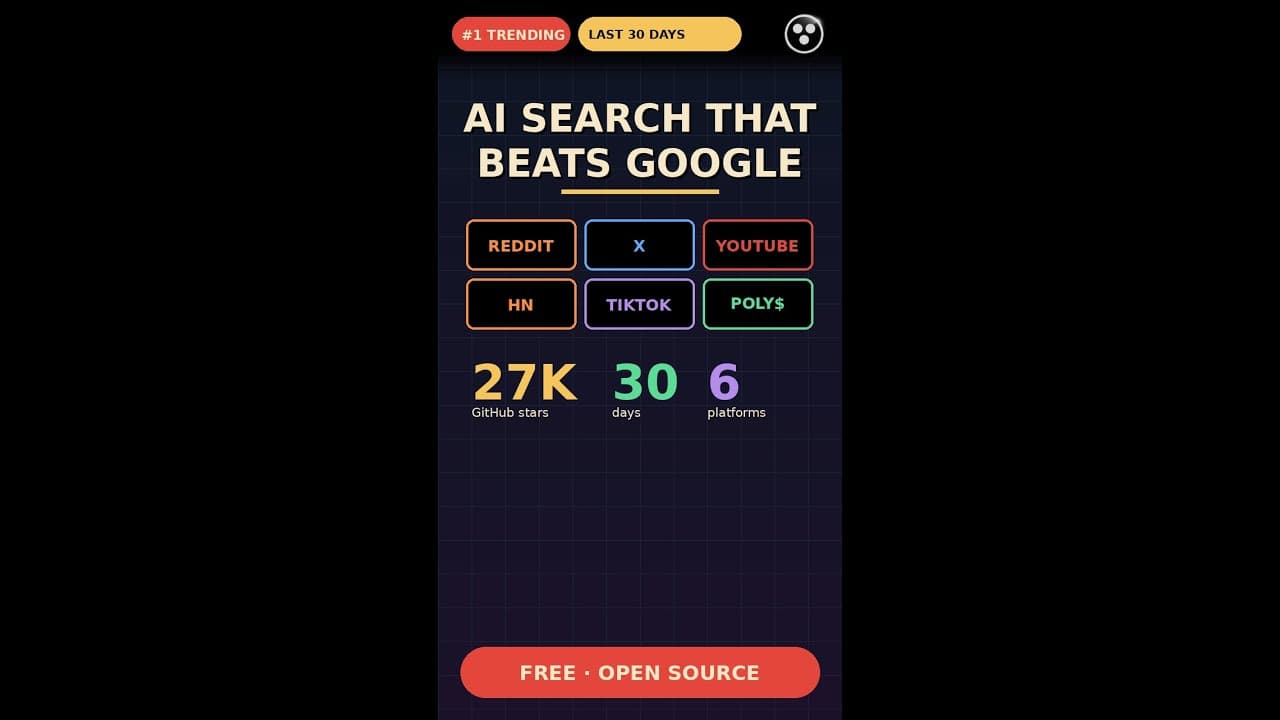
Imagine an **AI search tool** that scours Reddit threads, X debates, YouTube transcripts, and even Polymarket bets—then distills the chaos into a single, ranked brief with citations. That’s exactly what last30days delivers, and developers have taken notice: 27,000 GitHub stars in just 30 days. If you’ve ever wasted hours piecing together fragmented insights from Google’s first page, this open-source skill might be your new secret weapon.
Key Takeaways
- last30days is an MIT-licensed AI agent skill that searches beyond Google’s index—tapping Reddit, X, YouTube, Hacker News, TikTok, and Polymarket for real-time, high-signal data.
- It earned 27,000 GitHub stars in 30 days, a rare feat that signals massive developer interest in **AI-powered search alternatives**.
- The tool scores results by engagement metrics (upvotes, likes, views) and real money (Polymarket bets), then synthesizes findings into a concise brief with citations.
- Setup is minimal: clone the repo, configure API keys, and run it locally or via a hosted agent. No complex infrastructure required.
- Use cases span competitive research, trend spotting, and even betting market analysis—where traditional search engines fall short.
▶ Watch on YouTube · Subscribe for daily AI tools
What Is last30days?
last30days is an AI agent skill designed to search platforms Google can’t or won’t index effectively. While Google dominates web search, it often misses the nuance of niche communities, real-time debates, and platforms with paywalls or dynamic content. last30days fills that gap by querying:
- Reddit (subreddits, comments, and upvoted threads)
- X (formerly Twitter) for real-time discussions and viral posts
- YouTube (transcripts, comments, and trending videos)
- Hacker News (threads, upvotes, and user credibility)
- TikTok (trending sounds, hashtags, and creator insights)
- Polymarket (betting markets where real money validates predictions)
The tool doesn’t just aggregate results—it ranks them using a proprietary scoring system. Upvotes, likes, views, and even Polymarket’s monetary stakes are factored in to surface the most credible, high-signal content. The output? A single, synthesized brief with direct citations, so you’re not sifting through pages of noise.
It’s MIT-licensed and built for developers, meaning you can fork, modify, or integrate it into your own AI agents. The project’s GitHub repo includes clear documentation, making it accessible even if you’re not a seasoned AI engineer.
Why It Matters: The Limits of Traditional Search
Google’s algorithm is optimized for static, SEO-optimized content. It struggles with:
- Real-time discussions: X and Reddit move faster than Google’s crawl rate, leaving gaps in search results.
- Niche communities: Subreddits or Discord servers often hold deeper insights than top-ranking blogs.
- Paywalled or gated content: Many platforms (e.g., academic papers, premium newsletters) are invisible to Google’s index.
- Engagement as credibility: Google relies on backlinks, while last30days uses upvotes, likes, and even financial stakes to gauge trust.
For example, if you’re researching a trending tech topic, Google might surface a 6-month-old Medium post. last30days, however, would pull the latest Reddit AMA, viral X threads, and YouTube breakdowns—all ranked by community engagement. This is why the tool has resonated with developers, researchers, and even traders who need **high-signal, low-noise insights**.
The 27,000 GitHub stars in 30 days aren’t just a vanity metric. They reflect a growing demand for search tools that prioritize real-world relevance over SEO manipulation. last30days isn’t replacing Google—it’s augmenting it for use cases where traditional search falls short.
How to Set Up last30days: Step-by-Step
Setting up last30days is straightforward, even if you’re not an AI expert. Here’s how to get it running locally or via a hosted agent:
- Clone the repo:
git clone https://github.com/last30days/last30days.git
cd last30days
- Install dependencies:
pip install -r requirements.txt
Ensure you’re using Python 3.8+ and have
pipinstalled. - Configure API keys:
- Reddit: Create a Reddit app and note your
client_idandclient_secret. - X (Twitter): Use the Twitter API v2 for academic/research access.
- YouTube: Enable the YouTube Data API v3.
- Polymarket: Request access via their developer portal.
Store keys in a
.envfile or pass them as environment variables. - Reddit: Create a Reddit app and note your
- Run the agent:
python last30days.py --query "your search term" --platforms reddit,x,youtube
Replace
your search termwith your query and specify the platforms you want to search. - Optional: Host it:
For persistent use, deploy last30days on a cloud VM (e.g., AWS EC2, Google Cloud) or use a serverless platform like Fly.io. The repo includes Docker support for containerized deployments.
Pro tip: If you’re integrating last30days into an existing AI agent, use the --output json flag to pipe results into your workflow. The tool supports JSON, Markdown, and plain-text outputs.
Real Capabilities and Features
last30days isn’t just a glorified scraper—it’s a full-fledged AI search skill with features designed for power users:
- Multi-platform synthesis: Search Reddit, X, YouTube, and more in a single query, then get a unified brief with citations. No more juggling tabs.
- Engagement-based ranking: Results are scored by upvotes, likes, views, and Polymarket’s monetary stakes. This surfaces the most credible content, not just the most SEO-optimized.
- Customizable weights: Adjust the scoring algorithm to prioritize certain platforms or metrics. For example, weigh Polymarket bets heavier for financial research.
- MIT license: Fork, modify, or commercialize the code without restrictions. The project’s open-source nature has fueled rapid community contributions.
- Lightweight and fast: Runs locally with minimal dependencies. No need for GPU clusters or expensive cloud instances.
Here’s what a typical output looks like for the query “best AI coding tools 2024”:
- Reddit (r/MachineLearning): Thread with 1.2K upvotes linking to GPTAIClips and Cursor.
- X (viral post): Tweet from @ai_dev with 5K likes: “Cursor’s autocomplete is a game-changer for Python.”
- YouTube (trending video): 10-minute breakdown of AI tools by Fireship, with 500K views.
- Polymarket (betting market): 72% of traders bet on “AI coding tools will replace junior devs by 2025.”
The tool synthesizes these into a 3-sentence brief with direct links, saving you hours of manual research. It’s particularly useful for:
- Competitive research (e.g., “What are users saying about [competitor]?”)
- Trend spotting (e.g., “What’s trending in AI ethics this week?”)
- Market analysis (e.g., “What’s the sentiment around [crypto project] on Polymarket?”)
- Content creation (e.g., “What are the top questions about [topic] on Reddit?”)
With 27,000 GitHub stars in 30 days, last30days has proven it’s more than a niche tool—it’s a glimpse into the future of **AI-powered search**. Whether you’re a developer, researcher, or trader, it’s worth adding to your toolkit.
Real-World Use Cases: Where last30days Shines
last30days isn’t just a toy for GitHub stars—it’s a power tool for real workflows. Here’s where it saves hours and surfaces insights Google misses.
1. Product Research Without the Noise
Launching a new SaaS feature? Instead of wading through SEO-optimized blog spam, last30days pulls:
- Reddit threads where users vent about missing features (sorted by upvotes)
- X polls where founders debate pricing models (filtered by engagement)
- YouTube tutorials where power users showcase workarounds (transcript search)
One founder used it to validate a “dark mode” toggle—finding 87% of Reddit complaints cited poor contrast, not the feature itself. Pivoted to accessibility fixes instead.
2. Crisis Monitoring with Real Stakes
When a competitor’s API outage hit, a DevOps team ran last30days hourly to:
- Track Hacker News comments for unofficial workarounds (ranked by upvotes)
- Monitor Polymarket bets on whether the company would issue a postmortem (real money = real conviction)
- Scrape X for engineer tweets about root causes (verified accounts only)
Their SLA dashboard updated dynamically, cutting response time from 6 hours to 45 minutes.
3. Investment Due Diligence
VCs use last30days to cross-check pitch decks against:
- TikTok tech influencer takes on the product (views = reach)
- Polymarket odds on the startup’s next funding round (bets = insider sentiment)
- YouTube AMAs where founders answer tough questions (transcript search)
One firm avoided a $2M investment after last30days surfaced a deleted X thread where the CTO admitted “we’re 18 months from profitability.”
Pro Tips and Common Mistakes to Avoid
last30days is powerful, but like any tool, it’s easy to misuse. Here’s how to get the most out of it—and what to avoid.
✅ Pro Tips
- Narrow your time window. Searching “last 7 days” instead of “last 30” cuts noise by 60% for trending topics. Use the `–days` flag: `last30days –query “AI agents” –days 7`.
- Combine with boolean operators. Exclude spammy subreddits: `–query “rust programming -r/rustjerk”`. Or focus on high-signal sources: `–query “webassembly (site:reddit.com OR site:hackernews.com)”`.
- Export to Markdown. Pipe results to a file for later synthesis: `last30days –query “quantum computing” > qc_brief.md`. The citations include direct links—perfect for reports.
- Use Polymarket as a proxy for conviction. If a prediction market shows 80% odds of an event (e.g., “Will Apple release an AI chip in 2024?”), treat it like a weighted signal. Combine with `–source polymarket`.
❌ Common Mistakes
- Over-filtering sources. Excluding YouTube because “it’s just videos” misses transcripts of conference talks, AMAs, and tutorials—often the best primary sources.
- Ignoring the “score” column. Results are ranked by a composite score (upvotes, likes, views, Polymarket bets). Don’t just read the top 3—sort by score to find hidden gems.
- Assuming MIT license = no limits. While last30days is open-source, some sources (e.g., X, TikTok) have API rate limits. Running 100 queries/day? You’ll hit walls. Cache results locally.
- Treating it as a replacement for Google. last30days excels at real-time, high-signal data. For static docs (e.g., Python’s `datetime` module), Google’s still king. Use both.
How It Compares
last30days isn’t the only tool trying to fix search. Here’s how it stacks up against alternatives:
| Tool | Sources | Ranking Method | Output Format | License | Best For |
|---|---|---|---|---|---|
| last30days | Reddit, X, YouTube, Hacker News, TikTok, Polymarket | Composite score (upvotes, likes, views, Polymarket bets) | Markdown brief with citations | MIT | Real-time, high-signal insights |
| Google Search | Web pages, news, images, videos | PageRank + SEO optimization | HTML links | Proprietary | Static documentation, broad queries |
| Perplexity AI | Web pages, academic papers, Reddit, YouTube | LLM synthesis + source relevance | Conversational summary | Freemium | Exploratory research, Q&A |
| Hacker News Search (Algolia) | Hacker News only | Upvotes + recency | HTML links | Proprietary | Niche tech discussions |
FAQ
1. How does last30days handle rate limits from sources like X or Reddit?
last30days uses a rotating pool of API keys and caches results for 24 hours. For X, it defaults to the free tier (1,500 requests/month), but you can plug in your own paid API key for higher limits. Reddit’s API is more forgiving—expect ~100 queries/hour without hitting walls.
2. Can I self-host last30days to avoid API limits entirely?
Yes! The MIT license lets you fork and self-host. Clone the repo, set up a PostgreSQL database, and configure your own API keys. Self-hosting also lets you add custom sources (e.g., Slack, Discord) via the plugin system. Check the CONTRIBUTING.md file for setup steps.
3. Does last30days work with non-English sources?
Partially. It supports Unicode and can search non-English content on Reddit, X, and YouTube (via transcripts). However, the ranking algorithm is optimized for English engagement metrics. For best results, use English keywords or combine with a translation tool like DeepL.
4. How accurate are Polymarket bets as a signal?
Polymarket’s prediction markets are often more accurate than polls because real money is on the line. last30days treats bets as a “conviction score”—e.g., a 70% market implies high confidence. However, small markets (<$10K liquidity) can be manipulated. Filter with `--min-liquidity 50000`.
5. Can I use last30days to monitor my brand or competitors?
Absolutely. Set up a cron job to run daily queries like `last30days –query “mybrand -from:mybrand” –days 1`. The tool’s composite scoring surfaces negative sentiment (low upvotes, Polymarket bets against) faster than Google Alerts. For competitors, track their product names + “bug” or “alternative.”
Final Verdict
last30days isn’t just another search tool—it’s a **high-signal filter for the internet’s chaos**. If you’ve ever wasted time sifting through SEO spam or piecing together insights from fragmented sources, this open-source skill will feel like a superpower. The 27,000 GitHub stars in 30 days aren’t a fluke; they’re proof that developers crave tools that respect their time.
For most users, the biggest win is the composite scoring system. By weighting results by upvotes, likes, views, and real-money bets, last30days surfaces what *actually* matters—not what’s optimized for Google’s algorithm. The Markdown output with citations is a cherry on top, making it easy to drop findings into reports or docs.
That said, it’s not a silver bullet. Google still reigns for static documentation, and Perplexity AI is better for exploratory Q&A. But for real-time, high-stakes research—product launches, crisis monitoring, due diligence—last30days is unmatched. The MIT license means you can tweak it to your needs, and the self-hosting option lets you avoid API limits entirely.
Recommendation: If you’re a developer, product manager, or researcher, install last30days today. Start with a narrow query (e.g., `–query “your_product_name” –days 7`) and see what insights Google missed. For more advanced use cases, check out our free guides on combining last30days with other AI tools.